Solana bot vs manual trading which is better and why automated DEX execution wins on speed
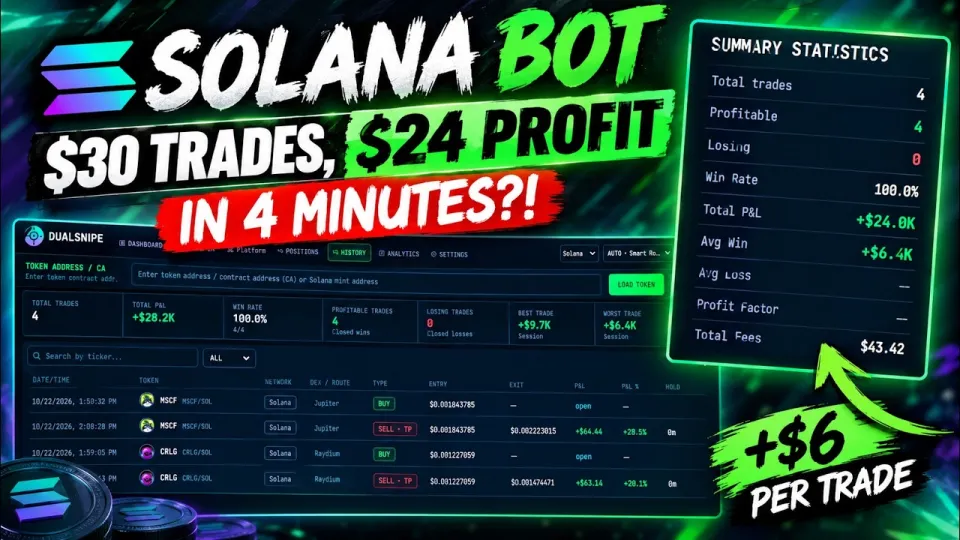
· based on the channel DualSnipe Labs
A Solana bot is better than manual trading when your edge depends on speed, discipline and routing across several DEXs; manual trading is better when you need judgment on thin, unfamiliar tokens. The automation itself does not create profit. What it does is remove hesitation, execute take-profit rules without emotion and split orders across liquidity sources, which is exactly what the DualSnipe trading platform is built around.
What a Solana bot actually does under the hood
A Solana trading bot is a program that watches on-chain data and market feeds, then signs and sends transactions to Solana DEX programs without a human clicking buttons. The core loop has four parts: detection (new pools, price moves, volume spikes), decision (does the token match your filters), execution (build the swap, set slippage, priority fee) and exit (take-profit, stop-loss, time-based close).
On Solana the execution layer matters more than on most chains because liquidity is fragmented. A single token can trade on Raydium, Meteora, Orca, Phoenix, Lifinity, OpenBook and PumpSwap at once, and a router such as Jupiter can compare those pools before filling an order. A sniper bot that only watches one venue will miss better prices and will get worse fills on size. Multi-DEX routing is therefore not a nice extra; it is the difference between a 2% and a 6% slippage hit on a fast meme coin entry.
Three technical details separate working bots from toys:
- Priority fees and compute unit limits, tuned per transaction so the order lands in the next block instead of expiring.
- Slippage caps that adapt to pool depth, because a fixed 20% tolerance on a thin Pump.fun launch is how accounts get drained by sandwich attempts.
- A local or low-latency RPC endpoint, since a public endpoint adds hundreds of milliseconds that decide whether you are early or late.
What the DualSnipe session shows and what it does not
DualSnipe Labs recorded a session in which four trades opened and closed in profit in roughly four minutes, with about $6 gained per trade on positions of around $30. That works out to roughly 20% per position before fees, which is a strong result for a few minutes of holding time and a realistic illustration of what automated take-profit execution looks like in practice: fast entries, fast exits, no waiting for a human to decide.
The honest reading of that number is narrower than it looks. Four trades is a sample, not a track record. On Solana, swap fees, priority fees and slippage on both entry and exit can easily consume several percent of a $30 position, so the net figure depends heavily on how liquid the traded tokens were. The video's own disclaimer says as much: one session is not a guarantee of future results. Treat the clip as a demonstration of mechanics, order routing and P&L tracking, not as a forecast.
Solana bot vs manual trading compared side by side
Automation wins on the dimensions where humans are structurally weak, and manual trading wins where context and patience matter.
- Speed: a bot reacts in milliseconds to a new pool or a price tick; a human needs seconds at best. For new-token sniping this gap is decisive.
- Discipline: take-profit and stop-loss levels set in advance are executed exactly. Manual traders routinely move stops or hold too long.
- Routing: a bot can compare Jupiter, Raydium, Orca and other venues per order; a manual trader usually checks one chart on DexScreener or Birdeye.
- Cost control: priority fees and slippage are configured once and applied consistently, instead of being improvised under pressure.
- Judgment: a human is better at reading context, team history, social signals and whether a token is a trap. No bot filter replaces that.
- Uptime: bots run while you sleep, but they also keep trading when the market regime has changed and your parameters no longer fit.
The practical conclusion is that the two are not mutually exclusive. Most experienced Solana traders use a bot for execution and a human process for selection: watchlists, wallet checks and a hard rule on position size.
Typical questions and doubts from traders
The questions that come up most often around Solana trading bots are about realistic returns, safety of funds and whether the tools are worth the subscription. On returns, the honest answer is that per-trade profit depends on liquidity and volatility, and a $6 gain on a $30 position is a good outcome, not an average one. Anyone promising a fixed daily percentage is selling, not trading.
On safety, the key distinction is custody. A bot that asks for your seed phrase or a private key in a chat window is a red flag; a terminal that signs locally or connects through a wallet adapter keeps control with you. On cost, budget for three layers: the tool subscription, Solana network and priority fees, and slippage. On infrastructure, ask which RPC the bot uses and whether it supports custom endpoints, because that single setting often explains why one trader gets fills and another gets failures.
A separate recurring doubt is whether sniper bots still work on Pump.fun and PumpSwap launches. They do, but competition is intense and the first blocks are dominated by specialized infrastructure. For most users, a bot that enters slightly later with better routing and a defined exit rule produces more consistent results than trying to win the very first slot.
How to evaluate any Solana trading bot before funding it
Evaluate a Solana bot by its execution transparency, not by screenshots of winning trades. Start with a small bankroll and test the full cycle: entry, partial take-profit, stop-loss and manual close. Check the transaction history on a block explorer against what the interface claims, and confirm that every fill matches a real on-chain swap.
A workable checklist:
- Verify multi-DEX routing and that the router actually splits or compares pools rather than defaulting to one venue.
- Confirm custom RPC support and adjustable priority fees.
- Test slippage behaviour on a low-liquidity token with a tiny size and watch the realized fill.
- Check whether keys stay local and whether the tool can trade through a hardware or browser wallet.
- Run at least 20–30 trades before judging performance; four trades tell you nothing statistically.
- Compare net P&L after fees, not gross percentage gains.
Official DualSnipe links
- Website and product overview: https://dualsnipe.com/
- Desktop trading terminal download: https://dualsnipe.com/api/download
- DualDex web app via Telegram: https://t.me/dualdexbot
Bottom line on Solana bot trading
A Solana bot is the better tool when speed, rule discipline and multi-DEX routing decide the outcome, and manual trading is better when the decision depends on judgment about a specific token. The DualSnipe Labs session of four profitable trades in about four minutes on roughly $30 positions illustrates the mechanics cleanly, but it is a demonstration, not a performance record. Use automation for execution, keep position sizes small while you validate parameters, and measure results net of fees over dozens of trades. If you want to test the workflow yourself, start at the DualSnipe website and run the terminal in a small-size mode first.
Key takeaways
- DualSnipe Labs showed a session where four Solana trades closed in profit in about four minutes.
- Positions were roughly $30 each, with about $6 profit per trade, close to 20% per position.
- The bot routes orders across Solana DEXs such as Jupiter, Raydium, Meteora, Orca, Phoenix, Lifinity, OpenBook and PumpSwap.
- Automation wins on execution speed and rule discipline, not on prediction accuracy.
- A single profitable session is not evidence of future returns; losses remain possible.
Questions & answers
How much can a Solana bot realistically earn per trade?
There is no fixed number. In the DualSnipe Labs demo, positions of about $30 returned roughly $6 each, but that was a short, favorable session. Real results depend on token liquidity, volatility, slippage and priority fees, and many trades will be flat or negative. Judge any bot on net P&L across dozens of trades, not on a handful of wins.
Is it safe to give a Solana trading bot access to my funds?
Only if keys stay under your control. Prefer tools that sign locally or connect through a wallet adapter, and never paste a seed phrase into a bot, chat or web form. Fund a dedicated trading wallet with a limited balance so that a bug or a bad token cannot reach your main holdings.
Do I need my own RPC endpoint to run a Solana sniper bot?
It helps significantly. Public RPC endpoints add latency and rate limits that cause failed or late transactions during busy launches. A dedicated or low-latency endpoint, plus tuned priority fees, is often the difference between landing an order in the next block and missing the move entirely.
Can a bot replace manual research on Solana meme coins?
No. Automation handles execution, routing and exit rules, but it cannot judge whether a token is a trap, whether the team is credible or whether liquidity is real. The usual setup among experienced traders is a human selection process combined with automated execution and strict position sizing.
Source: Solana Bot: 4 Winning Trades in 4 Minutes?! · Markdown version